
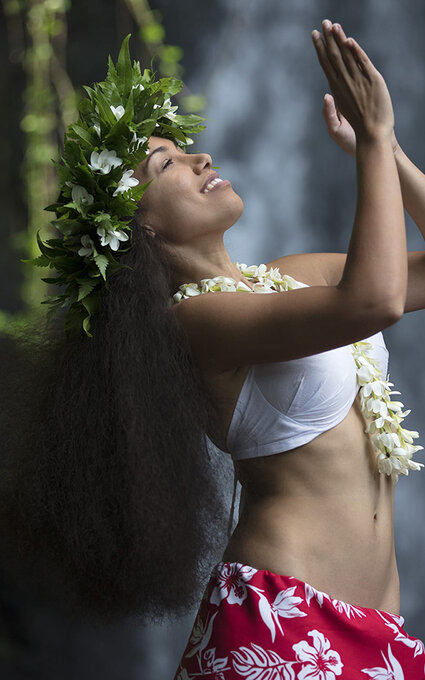
Tahitian Dance: The Cultural Treasure of French Polynesia
Tahitian dance, known as 'ori Tahiti, is an “artistic, social, and cultural art form coming from Tahiti and the Society Islands (Bora Bora, Moorea, Raiatea, Taha’a, Huahine…).” It is the most widely practiced type of dance in French Polynesia.
This traditional art of Tahiti has even conquered most of the world, with over 30,000 regular dancers across all continents. Whether you live in Latin America, the United States, France, or Japan, you will easily find a dance school offering 'ori Tahiti lessons if you live near a large city.

Tahitian dance: the heart of Polynesian identity
'Ori Tahiti is a big part of Tahitian and Polynesian culture. It's a mix of traditional dance, music, percussion, spoken performance ('ōrero), singing, and costumes. This beautiful art symbolizes the connection between Tahitian people and te fenua, the land that feeds them.
To express this bond, the dancer's body is symbolically divided in two: the legs represent the connection to the earth, while the body, head, and arms play with the elements—the ocean, the wind, and the skies.

Heiva i Tahiti, the best Polynesian dance shows
From a young age, children learn 'ori Tahiti, just as they learn reo Ma'ohi, the Tahitian language. Dance and reo ma’ohi are the pillars of their culture.
During the Heiva des écoles (for schools), young children are performing. As the young dancers progress in skill, their movements become more precise, the meaning behind the moves comes to light, and you begin to feel the deep connection to nature and culture behind each step.
During the Heiva i Tahiti, the professional groups are made up of dozens of performers, sometimes over a hundred. Nothing is more beautiful than seeing choreography come to life on stage. The lower body dances rhythmically, while the upper body is entirely devoted to graceful movement and expression. A dialogue unfolds between men and women, and between the drums and the voices.

Codified dances and choreography
Five distinct types of Tahitian dances are traditionally identified: 'ōte'a, 'aparima, hivināu, pā'ō'ā & pāta'uta'u.
The 'ote'a is undoubtedly the most iconic type of 'ori. It is probably what you imagine when you think of Tahitian dance. This ancient warrior haka, once reserved for men, has evolved to include women ('ōte'a vahine) and mixed groups of dancers ('ōte'a āmui). These performances are very rhythmic, powerful, precise, and require great mastery of steps and gestures.
The most moving dance is perhaps the 'Aparima. It is a mime based on the music or lyrics of the song being performed. The arms and hands, supported by subtle movements of the hips of the female performers, become a language. Each aesthetic movement is a word, forming a phrase and telling a story. The Tahitian dance becomes a form of writing, casting a spell over the audience.

Telling stories with movement
Speaking of storytelling, ancient Polynesian society did not have a written language. However, their knowledge was never lost between generations. Stories of gods, epic tales of their ancestors, family lineages, and celestial maps were all passed down from one generation to another.
One of the forms of 'ori Tahiti, the Pāta'uta'u, served this purpose. Sung by a soloist in a rhythmic, psalmodic style, this Polynesian dance was created as a mnemonic device. The choreography mirrored the rhythm, helping to memorize and transmit history.
The Living Heritage of 'Ori Tahiti and Tamure
During your stay, you will often hear people talk about Tāmūrē. Think of it as a synonym for 'ori Tahiti that allows for certain modern influences.
When you see a dance group performing - especially in hotels - you will hear several influences from other Polynesian cultures, such as the Marquesas Islands. But the cultural background remains the same: a beautiful, living expression of identity and history, which, like tattooing and language, almost disappeared during the missionary and colonial era. Polynesian dance has returned stronger, uniting dancers and reconnecting people to their shared heritage. Each step tells that story. Such intensity can only be experienced here, in The Islands of Tahiti.
Where and when can you see a Tahitian dance show?
Heiva i Tahiti in July: This festival in Tahiti is the largest event in French Polynesia. It shows the local culture through a Tahitian song and dance competition unlike any other in the world. If you’re visiting the island in July, grab a ticket for an unforgettable evening filled with spectacular choreography.
The Ori Tahiti Nui Competitions in November: This international ‘Ori Tahiti competition is dedicated to solo performances and small groups. The talent of the performers shines brightly during these exceptional performances. It’s also your chance to discover the world’s best dancers during the World Championships!
The Hura Tapairu in November: Open only to small ensembles, this must-see festival takes place at the end of the year (between November and December). Don’t miss its wonderful performances that honor the islands’ culture!
Festivals and other celebrations year-round: performances are often organized to open, close, or accompany the many major events that take place on our islands. Many of them are held in Tahiti, but you can also take the opportunity to explore other destinations, such as the Marquesas Islands Arts and Culture Festival, for example.
Traditional evenings every week: some hotels, restaurants, or culture centers like Tiki Village (on the island of Moorea) regularly host dance and music performances in the evening.
How about a little practice? During a traditional evening event, you might have the chance to be invited on stage for a few minutes to try your hand at some moves on stage! And if you want to practice, don’t hesitate to take a Tahitian dance class. Many instructors offer online classes. It’s a great way to get a little cardio workout while learning the basic moves and steps that will immerse you a bit deeper into our traditions and heritage.